
AI mention monitoring
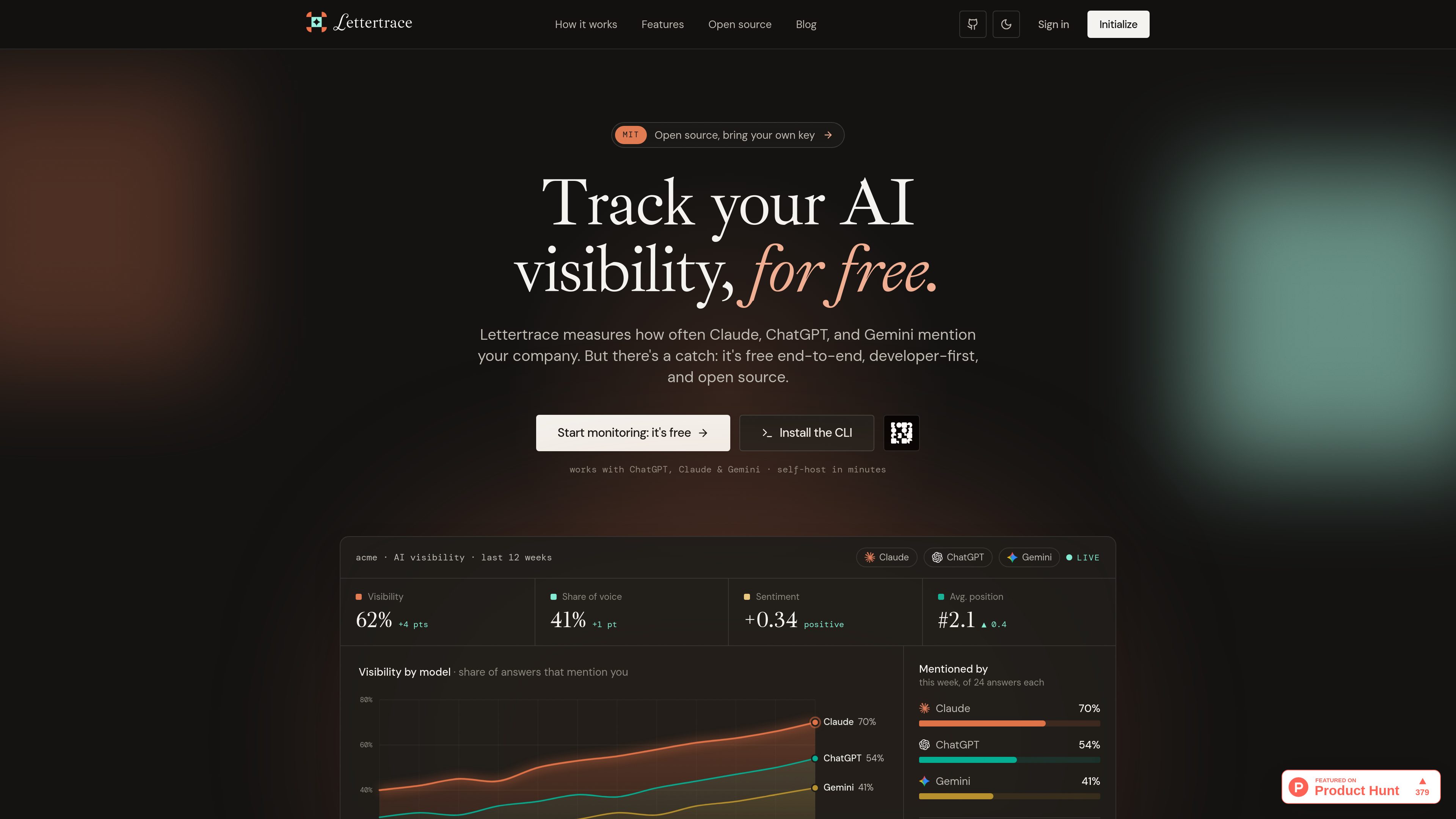
Measure whether Claude, ChatGPT, and Gemini mention a company in answers to monitored topics, with visibility shown by model and over time.

Lettertrace is an open-source, BYOK tool for monitoring how AI assistants mention and recommend brands. It helps teams track AI visibility, compare competitors, and follow changes across Claude, ChatGPT, and Gemini.
Lettertrace is an open-source, bring-your-own-key monitoring tool for measuring how brands appear in AI assistant answers. It checks responses from Claude, ChatGPT, and Gemini for brand mentions, ranking position, sentiment, recommendations, and competitive share of voice.
A monitoring run begins with a topic based on a buyer question. Lettertrace generates a set of natural prompts, queries the selected models, analyzes their answers, and turns each run into a data point for trend tracking. This gives teams a repeatable way to observe AI visibility instead of relying on occasional manual checks.
The product is designed for users who want to run and inspect the system themselves. It is MIT-licensed, supports user-provided Anthropic, OpenAI, and Google keys, and states that data is stored in the user's own Supabase. The site also provides a self-hosting workflow using npm and environment configuration.
Measure whether Claude, ChatGPT, and Gemini mention a company in answers to monitored topics, with visibility shown by model and over time.
Turn a single topic into dozens of natural-language questions, reducing the need to write and maintain every test prompt manually.
Review where a brand appears in answers and whether the response is classified as positive, neutral, or otherwise favorable or unfavorable.
Compare a tracked brand with selected competitors to see how answers are divided across the category and how that share changes.
Run checks daily or weekly so each result becomes part of a trend line that can be reviewed over successive monitoring periods.
Use Anthropic, OpenAI, and Google keys, run the MIT-licensed code yourself, and keep product data in your own Supabase according to the site.
Add the questions prospects ask about a category, generate prompt variations, and see how often the brand is included in AI-generated research answers.
Track competing brands alongside your own to identify who receives the most mentions, strongest positions, or largest share of voice for the same topics.
Use recurring runs and weekly trend lines to compare AI visibility before and after publishing comparison pages, product content, or other changes.
Review Claude, ChatGPT, and Gemini separately to determine whether a brand's visibility or sentiment varies by assistant.
Teams that need control over implementation can clone the MIT-licensed project, configure Supabase and provider keys, and run the application locally.
The site explicitly lists Claude, ChatGPT, and Gemini. It also names Google AI Overviews as an answer engine to watch, while the documented end-to-end examples focus on the three named assistants.
You add a topic based on what buyers ask, Lettertrace generates natural prompt variations, and the selected models answer those prompts. The answers are then checked for brand mentions, position, sentiment, and competitive share.
Yes. The site describes daily or weekly scheduled monitoring, allowing repeated runs to form a trend line over time.
Yes. Lettertrace uses a BYOK model and names Anthropic, OpenAI, and Google keys. The site says keys are encrypted at rest and do not leave the user's infrastructure.
Yes. The product is MIT-licensed and provides a setup example using Git, npm, an environment file, Supabase URL and keys, and a local development server. The supplied sources do not specify broader deployment requirements.
Los datos de tráfico son solo como referencia.

pluginsradar.com
Track ChatGPT plugin and app directory rankings to monitor search visibility, competitors, keyword gaps, listing completeness, and changes over time.

spate.nyc
AI-powered consumer trend intelligence for beauty, wellness, personal care, and food and beverage brands. Track demand across search and social signals.

peec.ai
Plataforma de analítica de búsquedas con IA para equipos de marketing y agencias SEO: mide la visibilidad de marca, compara competidores y analiza el rendimiento en ChatGPT, Perplexity y Gemini.

wellows.com
AI search visibility tracking and citation optimization for brands and agencies.

rivalsense.co
Turn competitor changes across online sources into weekly AI briefings for your business.

visiby.net
Plataforma de visibilidad en IA que rastrea cómo ChatGPT, Perplexity, Google AI Overviews, Google AI Mode y Claude mencionan o citan una marca para detectar oportunidades y priorizar mejoras.