
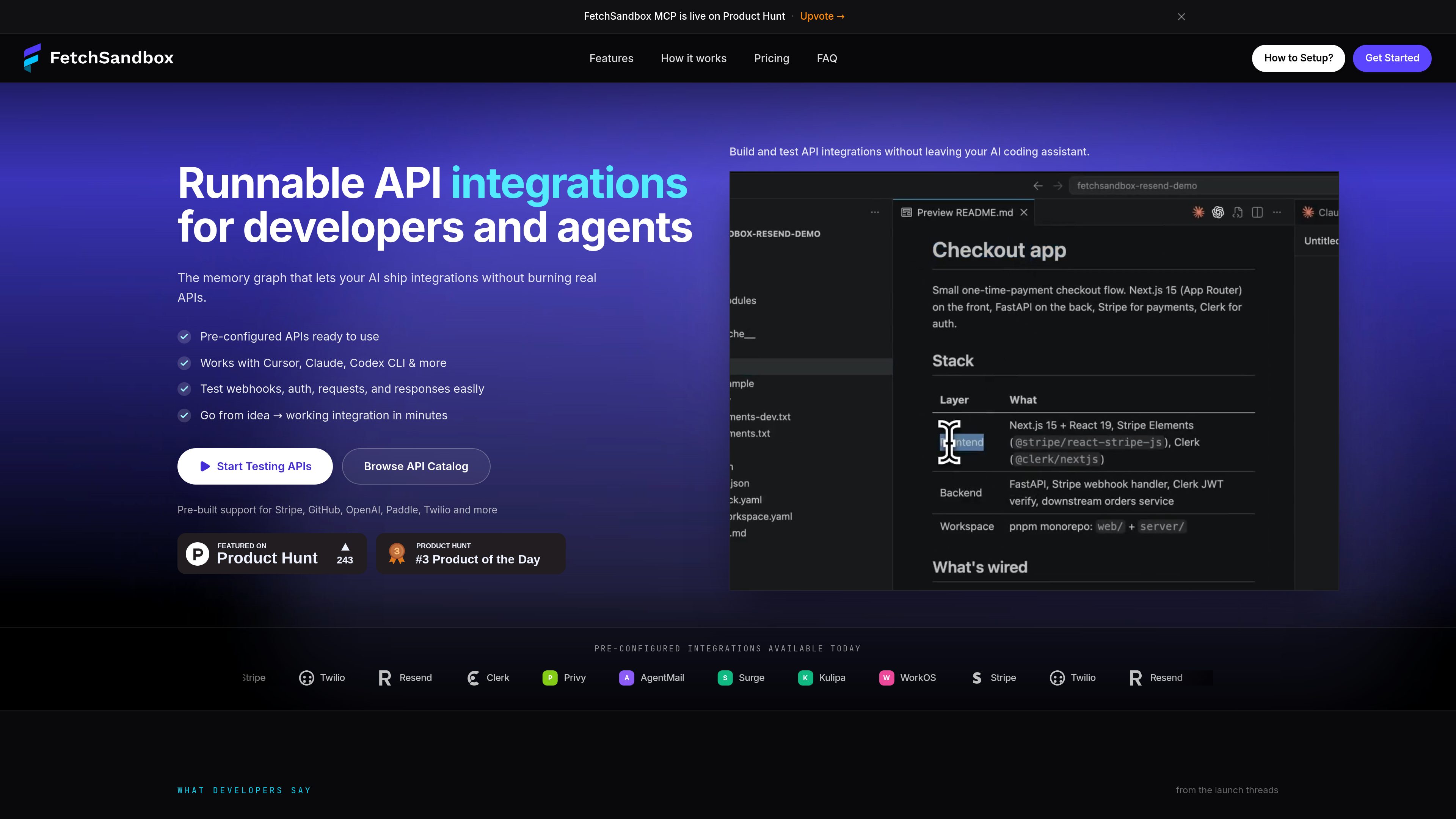
IDE and agent connection through MCP
One MCP configuration is presented as the way to connect FetchSandbox to supported coding assistants, keeping testing in the same environment where the integration is being written.

FetchSandbox es una herramienta para probar integraciones de API, webhooks y flujos de trabajo con estado desde entornos de programación con IA. Permite a desarrolladores y agentes validar integraciones sin usar claves API reales ni consumir la cuota de producción.
FetchSandbox provides runnable API sandboxes for developers and AI agents that need to test integrations without leaving an IDE. It connects through MCP to coding tools such as Cursor, Claude Code, Cline, Windsurf, and Codex, then lets users exercise real integration flows against supported APIs or imported OpenAPI specs.
The product focuses on stateful behavior rather than simple mock responses. According to the site, sandboxes preserve state across requests, emit webhook events on real transitions, and let users replay events or scenarios to check handler logic, retries, idempotency, and other integration edge cases before production.
One MCP configuration is presented as the way to connect FetchSandbox to supported coding assistants, keeping testing in the same environment where the integration is being written.
The site lists bundled support for services such as Stripe, GitHub, Twilio, OpenAI, Paddle, Resend, Clerk, and others, so teams can start with an existing sandbox instead of building everything from scratch.
FetchSandbox is designed to preserve resources and state across requests, so a created object can be used in later steps of the same scenario rather than acting like a single-response stub.
Webhook-focused sandboxes fire events on state transitions and support replay, which is useful for testing delivery handling, retries, and idempotency logic.
The platform can generate a working sandbox from an OpenAPI 3.x spec, with the source also noting support for OpenAPI 3.0, 3.1, and Swagger 2.0 with auto-conversion.
Pricing includes a free tier, a Pro plan for private integrations and higher usage, and an Enterprise plan with controls such as SSO/SAML, audit logs, and private storage.
Use the webhook sandbox to validate signature checks, duplicate deliveries, retries, out-of-order events, and missing-event fallbacks before a production deployment.
When an agent writes an integration inside Cursor, Claude Code, or another supported tool, FetchSandbox can be used to confirm that the workflow still works after the first successful response.
Teams can work against a pre-bundled provider sandbox, such as Stripe or GitHub, to exercise requests, state changes, and event callbacks without using real provider credentials.
If a team already has an API specification, they can upload it and use the generated sandbox to test request/response behavior and stateful workflows derived from the spec.
Because scenarios can preserve state and replay events, the product is suited to debugging regressions or rebuilding the steps that led to a failing handler or workflow.
The pricing page says no: you can pick an API and run it in an isolated sandbox without real keys, OAuth, partner onboarding, or touching production data.
A run is one complete integration scenario, not just a single API call. The site describes it as an end-to-end sequence that can include calls, preserved state, and webhook delivery.
Yes. The OpenAPI mock server page says you can upload an OpenAPI 3.x spec and generate a working sandbox from it.
The site names Cursor, Claude Code, Cline, Windsurf, Codex, VS Code, Claude Desktop, and Continue.dev in its installation and home-page material.
Yes. The pricing page lists a free plan and says no card is required, with paid plans available for private integrations, higher limits, and team controls.
Los datos de tráfico son solo como referencia.

developers.cloudflare.com
Kitesurf es el navegador sin estado de Cloudflare para agentes de IA y flujos de trabajo automatizados. Diseñado para ejecutarse en Workers, renderiza páginas, captura pantallas y extrae HTML con menos CPU y memoria que Chromium en tareas habituales de agentes.

quashbugs.com
Plataforma de pruebas y automatización de QA móvil para describir flujos en lenguaje natural, ejecutarlos en dispositivos Android o iOS reales y validar resultados en un solo flujo de trabajo.

plurai.ai
Plurai es una plataforma de confianza para agentes de IA que permite simular, evaluar y aplicar medidas de protección, para probar agentes en producción, supervisar su comportamiento y protegerlos en tiempo real antes y después del despliegue.

getbluejay.ai
Plataforma de control de calidad para agentes de IA que permite probar, supervisar y mejorar sistemas de voz y chat antes y después de su implementación.

nunu.ai
Plataforma de agentes de IA para automatizar pruebas de juegos y flujos de control de calidad mediante tareas de extremo a extremo en dispositivos reales, con paneles e informes para revisar los resultados.

signadot.com
Plataforma nativa de Kubernetes para entornos efímeros, ejecución automatizada de pruebas y flujos de validación reutilizables que permiten comprobar cambios con dependencias reales antes de fusionarlos.