
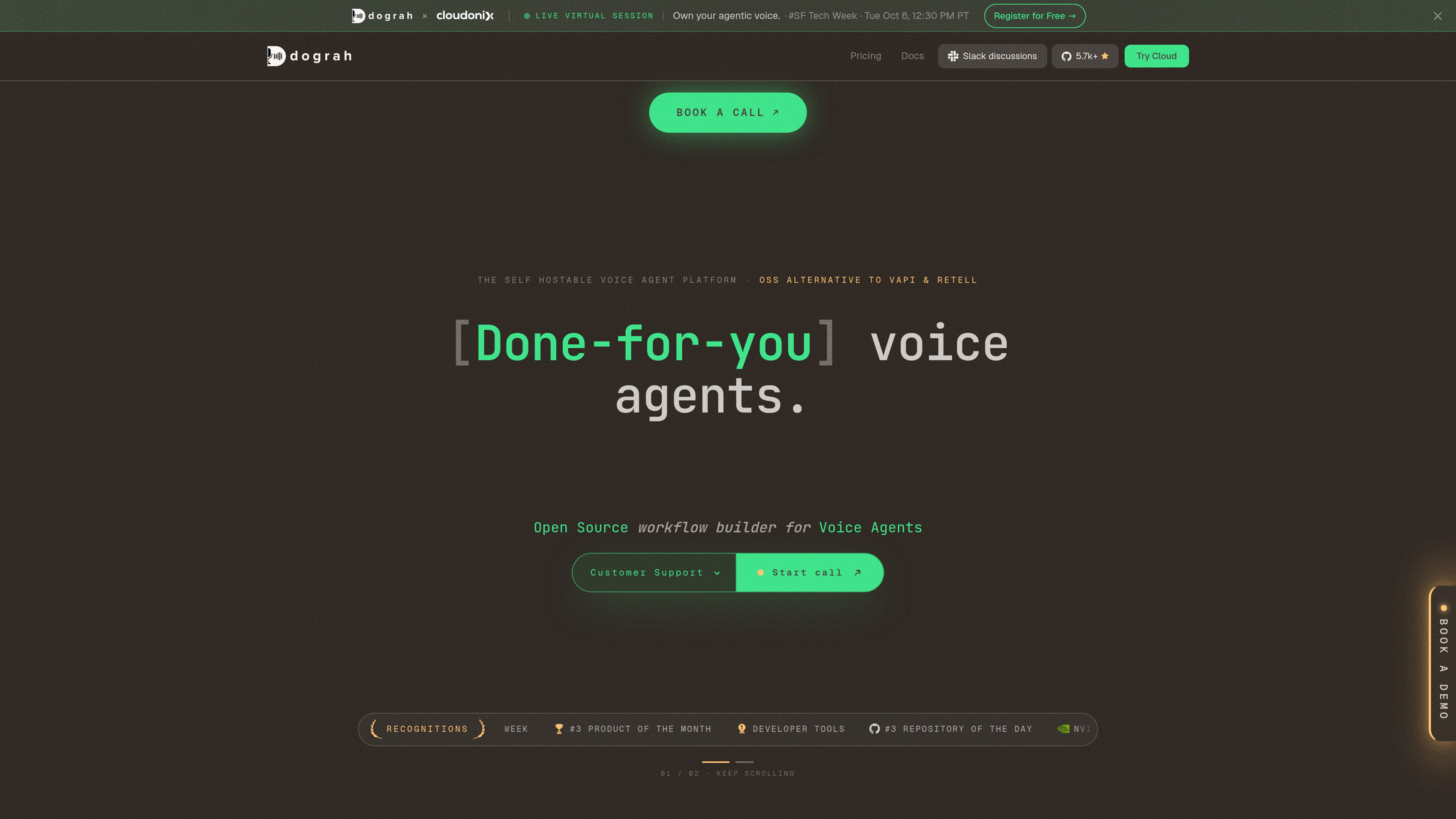
Visual voice-agent workflow builder
Build production voice agents with a no-code workflow builder for inbound and outbound calling. Workflows can include call logic, webhooks, and pre-call steps such as fetching CRM context.

Dograh es una plataforma de código abierto y autoalojable para crear y desplegar agentes de voz en producción. Conecta telefonía, voz, modelos de lenguaje, texto a voz, flujos de trabajo y observabilidad en tu infraestructura o en su nube gestionada.
Dograh is an open-source, self-hostable platform for building production voice agents. Its workflow builder connects telephony with speech-to-text, language models, text-to-speech, webhooks, and related call logic, while also supporting direct speech-to-speech pipelines.
Organizations can run the stack on their own servers, inside a private cloud or VPC, or use Dograh’s managed cloud. The platform is positioned for teams that want control over model providers and data location, including regulated organizations with requirements around data residency and auditability.
Build production voice agents with a no-code workflow builder for inbound and outbound calling. Workflows can include call logic, webhooks, and pre-call steps such as fetching CRM context.
Select providers for telephony, speech-to-text, language models, and text-to-speech, or replace the multi-step cascade with a speech-to-speech model. The site lists integrations including OpenAI, Google, Groq, OpenRouter, Azure, AWS, Hugging Face, Plivo, Telnyx, Twilio, Vonage, Asterisk, and multiple speech providers.
Dograh ships a Model Context Protocol server that lets compatible clients such as Claude Code, OpenClaw, Cursor, and Codex create, modify, and deploy voice agents from an IDE or agent runtime.
Audio-to-audio pipelines avoid the text round trip of a conventional STT, LLM, and TTS cascade. Dograh describes this mode as supporting real-time turn-taking and interruption handling, with Gemini and GPT Realtime options shown on the site.
Agents can combine prerecorded voice clips with live text-to-speech in the same cloned voice. A prerecorded line is used when it fits the interaction, with TTS available for responses that require generation.
The full stack can run on a customer’s servers, in a private cloud or VPC, or in a fully air-gapped environment. Dograh also offers managed cloud and private-cloud operations, with the private option keeping deployment inside the customer’s environment.
Create inbound or outbound support agents that handle voice interactions using configurable call workflows and connected telephony providers.
Use voice agents to contact or respond to property leads, gather qualifying information, and automate an initial lead-generation workflow.
Build outbound calling flows for activities such as sales outreach, event invitations, or EMI reminder and soft-collection scripts.
Use voice agents for patient scheduling, reminders, support automation, or law-firm call intake and routing, with deployment options intended for organizations managing sensitive information.
Deploy claim-status, banking, fintech, or public-sector voice workflows within an organization’s infrastructure when data residency and an existing compliance perimeter are important considerations.
Dograh can be run on the customer’s own servers, used as a managed cloud service, or deployed and operated inside the customer’s VPC. The site also describes fully air-gapped and in-perimeter deployments for supported environments.
Yes. Dograh is designed around bringing your own models and selecting providers for telephony, speech-to-text, language models, and text-to-speech. The site also lists self-hosted options such as Whisper, Voxtral, Kokoro, and Chatterbox; it notes that LLM swapping for self-hosted models is in beta.
Dograh provides an MCP server that compatible clients can use to create, modify, and deploy voice agents. The site names Claude Code, OpenClaw, Cursor, and Codex as examples of clients or runtimes that can connect to it.
Yes. In addition to the conventional STT-to-LLM-to-TTS cascade, Dograh supports speech-to-speech pipelines in which audio is sent in and audio is returned directly.
The self-hosted open-source platform is described as free forever with no platform limits. Dograh also offers managed options, including usage-based cloud service, committed volume, and custom private or on-premise plans.
Los datos de tráfico son solo como referencia.

thunderphone.com
ThunderPhone es una plataforma de agentes telefónicos con IA para crear, probar y desplegar agentes de voz para llamadas entrantes, salientes y realizadas desde la web o una aplicación. Está pensada para equipos que necesitan gestionar llamadas en producción con telefonía, compatibilidad lingüística e integraciones de flujos de trabajo en una sola pila.

vdf.ai
VDF AI es una plataforma empresarial de orquestación de agentes de IA que coordina agentes, modelos, herramientas, recuperación y flujos de trabajo bajo una gobernanza centralizada. Puede usarse como servicio en la nube gestionado o desplegarse en una nube privada, centro de datos, entorno soberano, cuenta de AWS o infraestructura aislada.

baserow.io
Baserow es una plataforma de bases de datos sin código y de código abierto para crear bases de datos, aplicaciones, paneles y automatizaciones, en la nube o mediante alojamiento propio.

gatling.io
Gatling es una plataforma de pruebas de carga para equipos que necesitan crear, ejecutar, analizar y automatizar pruebas de rendimiento. Admite flujos de trabajo basados en código, de bajo código y sin código, con planes de pago y una opción Enterprise para equipos más grandes.

getgrist.com
Grist es una hoja de cálculo-base de datos relacional para organizar datos estructurados, crear flujos de trabajo y colaborar en documentos. Ofrece opciones en la nube, autoalojadas y empresariales, además de un plan gratuito y pruebas de pago.

webiny.com
CMS headless de código abierto y autohospedado para que los equipos gestionen contenido estructurado, sitios web y archivos bajo su propio control, con despliegues en AWS, multiinquilinato, flujos de trabajo y extensibilidad para desarrolladores.